

Newsroom
Looking for something specific? Search through our press releases by keyword:
Find Releases by Date
- January 2026
- December 2025
- November 2025
- October 2025
- September 2025
- August 2025
- July 2025
- June 2025
- May 2025
- April 2025
- March 2025
- February 2025
- January 2025
- December 2024
- November 2024
- October 2024
- September 2024
- August 2024
- July 2024
- June 2024
- May 2024
- April 2024
- March 2024
- February 2024
- January 2024
- December 2023
- November 2023
- October 2023
- September 2023
- August 2023
- July 2023
- June 2023
- May 2023
- April 2023
- March 2023
- February 2023
- January 2023
- December 2022
- November 2022
- October 2022
- September 2022
- August 2022
- July 2022
- June 2022
- May 2022
- April 2022
- March 2022
- February 2022
- January 2022
- December 2021
- October 2021
- September 2021
- August 2021
- July 2021
- June 2021
- May 2021
- April 2021
- March 2021
- February 2021
- January 2021
- December 2020
- November 2020
- September 2020
- July 2020
- June 2020
- May 2020
- April 2020
- March 2020
- February 2020
- January 2020
- December 2019
- November 2019
- October 2019
- September 2019
- July 2019
- June 2019
- May 2019
- April 2019
- March 2019
- February 2019
- January 2019
- December 2018
- November 2018
- October 2018
- September 2018
- August 2018
- January 2018
- November 2017
- August 2017
Senate Democrats Introduce First Five Bills of 2026 Session
Legislation expands affordable housing, lowers utility bills, encourages environmental stewardship, builds safer communities, and protects civil rights
DENVER, CO – The Colorado Senate Democrats unveiled their First Five Bills of the 2026 legislative session today.
The bills aim to increase affordable housing stock, lower utility bills for low-income Coloradans, boost electric vehicle battery re-use and recycling, build safer communities, and protect Colorado from threats to civil rights.
“We’re excited to kick off the 2026 legislative session focused on lowering costs, boosting public safety, protecting our environment, and meeting the moment to make life better for Coloradans,” said Senate President James Coleman, D-Denver. “We have 120 days to make an impact, and that work starts today.”
“We’re ready to deliver for Coloradans this legislative session,” said Majority Leader Robert Rodriguez, D-Denver. “Over the past few years we’ve worked hard to make Colorado a great place to live, work, and raise a family, but there is more work for us to do. As I begin my final session, I know our caucus is ready to act boldly and lead with courage amid federal threats to our way of life and significant budget constraints. Our First Five Bills of the 2026 legislative session reflect our commitment to lowering costs and protecting Coloradans’ rights and freedoms.”
SB26-001
Senator Dylan Roberts, D-Frisco
Representatives Andrew Boesenecker, D-Fort Collins, & Chris Richardson, R-Elbert County
Currently, counties are prohibited from using general fund property tax revenue to support multi-jurisdictional or statutory housing authorities, like the Eagle County Housing and Development Authority in Senator Roberts’ district. Senate Bill 1 cuts red tape by removing that restriction; providing counties the ability to use property tax revenue to support workforce housing and housing authorities.
SB26-002
Senators Cathy Kipp, D-Fort Collins, Tony Exum, Sr., D-Colorado Springs
Representative Jenny Willford, D-Northglenn
Affordable electricity is increasingly crucial as Colorado transitions to renewable energy. Senate Bill 2 tackles unaffordable utility bills through creation of the FARE (First Allotment of Residential Electricity) service program. For income-qualified customers of an investor-owned utility, the program would provide a minimum level of electricity needed to support basic living needs at a marginal cost rate. The bill also stipulates that implementation of the FARE service must not directly increase the cost of utility services for other customers.
SB26-003
Senators Katie Wallace, D-Longmont, & Lisa Cutter, D-Jefferson County
Representative Kyle Brown, D-Louisville
Colorado is a national leader in electric vehicle (EV) adoption and keeping that momentum is critical to addressing air pollution, as transportation is the leading cause of greenhouse gas emissions in the state. Senate Bill 3 would expand last year's Battery Stewardship Act to include EV batteries and put the Colorado Department of Public Health and Environment Hazardous Waste Division in charge of regulating end-of-life management for electric vehicle batteries. The bill provides the framework for the reuse and repurposing of economically viable batteries via the free market, while ensuring that unwanted batteries are responsibly recycled and not improperly stored or disposed.
SB26-004
Senator Tom Sullivan, D-Centennial
Representative Meg Froelich, D-Englewood
Senate Bill 4 would add health care facilities that employ co-responders and health care professionals to the list of community members that may petition the court for an extreme risk protection order (ERPO). It would also add health care facilities, behavioral health treatment facilities, K-12 schools, and higher education institutions as institutional petitioners that may petition a court for an ERPO.
In 2019, Colorado Democrats passed legislation allowing for the issuance of ERPOs, wherein qualified individuals may petition a judge to temporarily remove a firearm from a potentially dangerous individual and interrupt gun violence before it has a chance to occur. In 2024, the most recent data available, there were 164 ERPO petitions filed in Colorado.
SB26-005
Senators Mike Weissman, D-Aurora, & Julie Gonzales, D-Denver
Representatives Javier Mabrey, D-Denver, & Yara Zokaie, D-Fort Collins
Currently, there is no adequate legal remedy in state or federal court for federal constitutional violations by officials in immigration enforcement. Senate Bill 5 protects constitutional rights by establishing a state court cause of action for damages suffered through violation of the U.S. Constitution in the context of civil immigration enforcement. Under the bill, those found responsible for violations could be held liable for legal or equitable relief, and any claims would have to be filed within two years of the incident.
Senate President James Coleman Delivers Opening Day Remarks
DENVER, CO – Colorado Senate President James Coleman, D-Denver, today delivered his Opening Day Remarks to kick off the 2026 legislative session.
Below is a transcript of Coleman’s remarks as prepared for delivery:
Good morning! Welcome to the second regular session of the 75th General Assembly. It is my honor to be with you all this morning to celebrate the beginning of another legislative session.
I’d like to begin by welcoming our guests this morning. So many family and friends, former lawmakers – basically everyone who doesn’t have to be here when our debates stretch into the night or, God forbid, the weekend.
They aren't here in the chamber today, but I want to acknowledge my family as well. They are my rock, and I would not be here today without them.
Shayna – my wife, and partner of 25 years, thank you for being there to celebrate my successes, for lifting me up on the more challenging days, and for taking on every day together in partnership.
Naomi and James – one of the main reasons I do this work is for you. To help build a future where every door is open and every opportunity is waiting for you. My first opening day, you were both small enough to sit on my lap. Flash forward ten years, you’re behind the wheel of a car. I am so proud of both of you and every day you make me grateful to be your dad.
I would like us all to extend thanks to all our nonpartisan staff, who have seen some changes since we were here this summer for our special session. Join me in welcoming our new members of the Senate team, and members taking on new roles on the team: Olivia Hart, Mary Ann Admire, Matthew Rivera, Benjamin Noren, Dennis Pinto, and Jerry Touslee.
Welcome to the Senate, we’re so happy to have you join the family. And thank you to the returning staff – I’m grateful to work alongside you another year.
If you know me, you know that I don’t do any of this alone. I’d like to thank our Senate leadership team – Majority Leader Rodriguez, President Pro Tempore Michaelson Jenet, Assistant Majority Leader Cutter, Caucus Chair Roberts, and our whip, Senator Hinrichsen – for their help in keeping this train on the tracks.
I also can’t do this without the greatest Minority Leader this chamber has ever seen, Alamosa’s own, Senator Cleave Simpson. It’s an honor to lead alongside you.
We must also give a warm welcome to the newest member of the upper chamber: Senator William Lindstedt! Just wait until you see how efficient we are over here.
I’m just kidding though, of course we love our friends in the House. And I’d be remiss if I didn’t wish the good Speaker McCluskie well in her final session in the House.
Her work to invest in Colorado’s future will be transformative. Whether through implementation of a new school funding formula that ensures resources are going directly to students that need them most, her dedication to protecting Colorado’s water future, and her hand in ensuring access to affordable health care for all – it has been an honor to learn from her and lead alongside her, and I will miss her partnership.
Speaker, don’t forget about us on the other side, and please don’t be a stranger!
And to Governor Polis, who is also entering his final year as the leader of our state. It’s been a privilege to work with you in this leadership capacity and I look forward to all that we’ll accomplish together this year. I can’t wait to hear your final – and I’m sure best – State of the State tomorrow. Last year I learned that my assigned seat is fully in view on the Colorado Channel. I’ve been practicing my facial expressions and reactions all week. I’m ready!
Colleagues, we have been through a lot together over the past year. We have fiercely debated policies with one another, we have deliberated on Colorado’s toughest issues, we have celebrated wins.
And, colleagues, we have grieved together.
We continue to mourn the unexpected, tragic loss of one of our own: Senator Faith Winter.
Faith’s loss is immeasurable, and as we embark on our work this session I hope that we can incorporate her tenacity and the joy that she found in this work into our policies, as well as in the conversations we have with one another.
Because Faith never forgot to be moved by the people behind her policies. She never forgot how to be human in this work – flaws and all.
She would work with anyone who would work with her. A coalition and team builder for the ages, she would not let the letter after someone’s name, a district number, or the county they call home get in the way of getting good policy over the finish line.
Policy that puts Coloradans, and Colorado, first.
We will miss her presence in our chamber each and every day. She showed up with a warmth and brightness reflected in the clothing she wore, the fresh flowers on her desk, and, most of all, in her smile and friendly hello.
May we honor Faith not only in memory, but in how we show up for the work and for one another.
Colleagues, we have accomplished so much together.
In just the last year, we stepped up to protect safety net providers through legislation sponsored by Senators Mullica and Kirkmeyer to ensure Coloradans everywhere from Craig, Cortez, to Crowley are able to receive the health care they need.
We set Colorado kids up for greater prosperity by increasing school funding through last year’s School Finance Act and creation of the Kids Matter Fund, thanks to Senators Bridges and Kolker.
We made Colorado a national leader in reproductive rights and we have stood up for a woman’s right to determine her own future, most recently through passage of legislation like Senators Gonzales and Weissman’s Emergency Medical Treatment and Labor Act and Senators Daugherty and Rodriguez’s legislation to implement the will of the voters and guarantee coverage for abortion care to Coloradans on Medicaid.
Over the interim, I had the privilege of visiting every member in their district all across the state:
Senator Rich was kind enough to drive me through District 7 to see the beauty of the Colorado National Monument and understand the vitality of the Western Slope;
I traveled up to District 17 to visit Senator Wallace and catch up over a beer at Oskar Blues;
In District 10, Senator Liston and I toured UCCS and learned about their state-of-the-art cybersecurity systems;
And I joined Senator Roberts at a town hall in District 8 and got to visit Strawberry Hot Springs.
Not to mention that Minority Leader Simpson and I got to check out some of the coolest cars I’ve ever seen at a car show in Alamosa.
At each of these visits we reflected on our progress and talked about the challenges still facing Coloradans. Colleagues, I’m here to tell you that we are not as divided as some might want you to believe. Coloradans need a safe place to live, they need to be able to go to the doctor without driving for miles or paying a fortune, they need to be able to afford gas, groceries, and childcare. They need clean drinking water and enough water to work the land and grow livestock and crops. And they need us to stand up for their rights and protect their liberties.
To accomplish these goals, we must be courageous leaders and lawmakers.
Because we are facing headwinds and will have to confront serious challenges.
Our budget environment will mean extremely difficult funding decisions. The federal government’s tariffs and haphazard clawbacks of funding for critical programs have sown uncertainty in our economy. They threaten our ability to provide the resources Colorado kids and families, seniors, and rural communities depend on.
Colleagues, we are here to work for Colorado, for Coloradans. I know each of us are capable of doing so, because I have seen us do it before. So, I call on each of you to continue to, once again, govern courageously. My great hope is that each of us shows up here ready to work with one another to make life better for Coloradans.
We have, and will, work across the aisle to build a better Colorado – because the challenges facing our state demand nothing less.
People across our state are having to stretch their dollars further just to make ends meet. Rent and housing prices are leveling off but remain high. Groceries, insurance, utility bills, and everyday expenses are making monthly budgets a math problem that is increasingly more impossible to solve.
We have a role to play here. We won’t sit idly by while Coloradans are hurting.
As we enter Colorado’s 150th year of statehood, we will tackle the big issues head on. Our work this legislative session can and will improve outcomes for Coloradans in every corner of the state.
We will build an economy that rewards hardworking people and where every Coloradan has a fair chance to thrive.
This year we will work to build up affordable housing stock to increase opportunities for homeownership and lower housing prices for everyone. By stabilizing health care premium rates to keep more people on their plans, we can keep insurance premiums manageable for us all. We will continue to take on deceptive pricing practices and hold corporations accountable who pad their pockets at the expense of working families.
This year, we will also work to streamline workforce programs to help more Coloradans enter highly-skilled careers and fill in-demand positions – strengthening our economy to create more resiliency in the face of turbulent national tides.
We’ll follow through on our commitments to reach our climate goals and invest in diverse energy sources to drive down utility costs and bolster an economy that’s ready for our rapidly changing future.
We will also govern with the confidence guaranteed to us by our Constitution. Our rights and our freedoms are non-negotiable, and we will find the strength required to do our work knowing that we stand on the right side of history, and on the shoulders of leaders who fought for the freedoms and democracy we enjoy today.
Our work this year will lift us all.
Now, many of you know I am a minister. I won’t preach too much this morning, but I do want to leave you with a few lines of scripture. Matthew 25:
"For I was hungry and you gave me something to eat, I was thirsty and you gave me something to drink, I was a stranger and you invited me in, I needed clothes and you clothed me, I was sick and you looked after me, I was in prison and you came to visit me.’
Then the righteous will answer him, ‘Lord, when did we see you hungry and feed you, or thirsty and give you something to drink? When did we see you a stranger and invite you in, or needing clothes and clothe you? When did we see you sick or in prison and go to visit you?’
The King will reply, ‘Truly I tell you, whatever you did for one of the least of these brothers and sisters of mine, you did for me.’
Let us work this year for our brothers and sisters who need our help the most. When we do, we will serve something bigger, greater than each of us in this room. When we do, we’ll see Colorado’s future in each and every constituent we serve.
So let us rise to the challenges facing our state and our collective future – as I know that we can. And let us fill Faith’s shoes and be moved by the work. See each other as equals, and as humans.
Let us build a Colorado for everyone.
Our work in this building does not end on sine die or when we leave this building, but it does begin today.
Colleagues, thank you for your time this morning.
We have our work cut out for us. Let’s do this.
Thank you.
Democratic Leadership, JBC Members Release Statement After Trump Freezes Child Care, Social Services Funding
DENVER, CO – Democratic Leadership and members of the Joint Budget Committee today released a statement responding to the Trump Administration’s freeze of more than $300 million of funding for child care and social services for the state’s most vulnerable.
Statement from Speaker Julie McCluskie, D-Dillon, Senate President James Coleman, D-Denver, House Majority Leader Monica Duran, D-Wheat Ridge, Senate Majority Leader Robert Rodriguez, D-Denver, JBC Chair Emily Sirota, D-Denver, and JBC Member Judy Amabile, D-Boulder:
“The Trump Administration’s callous decision to freeze more than $300 million will only make life more expensive for hardworking families.
“Gutting programs that equip tens of thousands of Coloradans with resources to provide and afford child care is a direct attack on working families. The Colorado Works program directly helps low-income Coloradans afford everyday necessities, including food and clothing, and get ahead through job training. Federally supported programs strengthen Colorado’s economy and create strong pathways for workers to earn more and thrive.
“We stand ready to work with Governor Polis and partners in our federal delegation to resist this lawless effort to freeze funding, and we sincerely hope that our Republican colleagues will put politics aside, get serious about making life in Colorado more affordable, and put families first.”
This week, the Trump Administration froze funding for Colorado’s Temporary Assistance for Needy Families (TANF) program, known here as Colorado Works, which supports thousands of families across the state. The basic cash assistance component alone supports over 50,000 children. The Administration also froze funds for the Child Care and Development Fund and Social Service Block Grants, which are used to provide a broad range of services for vulnerable Coloradans, including child welfare services.
Majority Leader Rodriguez Announces Updated Senate Committee Assignments
DENVER, CO – Senate Majority Leader Robert Rodriguez, D-Denver, today announced updated Senate committee assignments for the upcoming 2026 legislative session.
“Committees are crucial to the legislative process – they’re where we deliberate, hear from the public, and fine-tune policies so that they can have the best impact for Coloradans,” said Rodriguez. “I’m excited to announce committee assignments for the 2026 legislative session and know that our caucus members are ready to get to work.”
Updated committee assignments are below, with new committee members italicized. Members taking on a new role within a committee upon which they already serve are indicated by an *. Additionally, the Business, Labor, and Technology Committee is shrinking from a seven person committee to a five person committee.
Agriculture & Natural Resources, 7 members (4-3)
Senator Dylan Roberts, Chair
Senator Jessie Danielson, Vice Chair
Senator Nick Hinrichsen
Senator Cathy Kipp
Appropriations, 7 members (4-3)
Senator Judy Amabile, Chair
Senator Jeff Bridges, Vice Chair
Senator Julie Gonzales
Senator Chris Kolker
Business, Labor, & Technology, 5 members (3-2)
Senator Jessie Danielson, Chair
Senator Nick Hinrichsen, Vice Chair
Senator Iman Jodeh
Education, 7 members (4-3)
Senator Chris Kolker, Chair
Senator Janice Marchman, Vice Chair
Senator Cathy Kipp
Senator Dafna Michaelson Jenet
Finance, 9 members (6-3)
Senator Cathy Kipp, Chair
Senator Janice Marchman, Vice Chair
Senator Julie Gonzales
Senator Chris Kolker
Senator Kyle Mullica
Senator Marc Snyder
Health & Human Services, 9 members (6-3)
Senator Kyle Mullica, Chair
Senator Dafna Michaelson Jenet, Vice Chair
Senator Lisa Cutter
Senator Lindsey Daugherty
Senator Iman Jodeh
Senator Mike Weissman
Judiciary, 7 members (5-2)
Senator Mike Weissman, Chair*
Senator Dylan Roberts, Vice Chair*
Senator Lindsey Daugherty
Senator Nick Hinrichsen
Senator Katie Wallace
Local Government & Housing, 7 members (4-3)
Senator Tony Exum, Sr., Chair
Senator Marc Snyder, Vice Chair*
Senator William Lindstedt
Senator Matt Ball
State, Veterans, & Military Affairs, 5 members (3-2)
Senator Katie Wallace, Chair
Senator Tom Sullivan, Vice Chair
Senator William Lindstedt
Transportation & Energy, 9 members (6-3)
Senator Lisa Cutter, Chair*
Senator Matt Ball, Vice Chair
Senator Tony Exum, Sr.
Senator William Lindstedt
Senator Kyle Mullica
Senator Tom Sullivan
Senate Democratic Leadership Welcomes Senator William Lindstedt to Colorado Senate
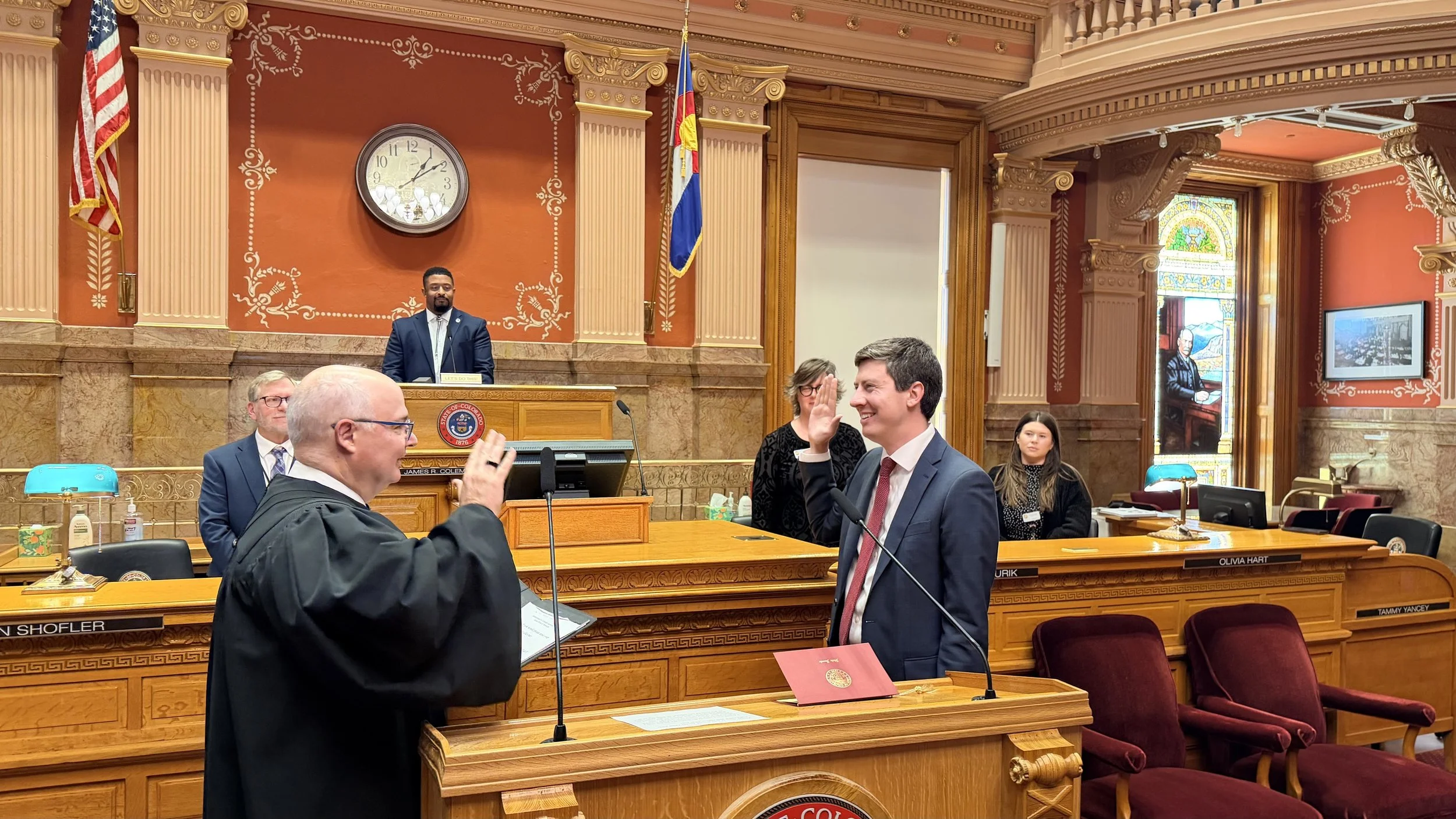
Senator Lindstedt is sworn in by Colorado Supreme Court Justice Brian D. Boatright.
DENVER, CO – Following his official swearing in by Justice Brian D. Boatright, Senate President James Coleman, D-Denver, and Senate Majority Leader Robert Rodriguez, D-Denver, today welcomed Senator William Lindstedt, D-Broomfield, to the Colorado Senate.
“William Lindstedt will be a strong addition to the Colorado State Senate, bringing experience from Broomfield City Council and the Colorado House of Representatives, including as a committee chair,” said Coleman. “We thank Senator Lindstedt for stepping up and we know he will serve with hard work and integrity.”
“We send a heartfelt welcome to William Lindstedt as he joins the Colorado State Senate,” said Rodriguez. “With a proven track record of public service, I am confident that he will be a great partner in achieving our goals of making Colorado more affordable and tackling Colorado’s budget challenges while protecting core services.”
“I’m incredibly grateful to serve as the next State Senator for Senate District 25, representing Broomfield, Northglenn, and Westminster,” said Lindstedt. “This was not how I expected to enter the State Senate, and I know the loss of Senator Winter has been devastating for our community, and for many of us very personally. With the legislative session approaching, I’m ready to get to work immediately to protect Colorado’s clean air and water, boost our public schools, safeguard Medicaid, and stand up to federal overreach.”
Senator William Lindstedt represents Senate District 25, Adams, Broomfield, and Weld Counties. In the House, he was Chair of the House Finance Committee, Chair of the Legislative Audit Committee, and served as a member of the Business & Labor Committee, Transportation, Housing, and Local Government Committees. He has passed dozens of bills to lower the cost of living, fix infrastructure, improve public schools, protect the environment, and make communities safer. Lindstedt is a former assistant bench jeweler, public transit outreach advocate, community organizer, and former member of the Broomfield City Council.
JOINT RELEASE: Right to Repair Electronic Equipment Law Goes Into Effect
DENVER, CO – On January 1, 2026, legislation goes into effect to save consumers money and combat electronic waste. HB24-1121 extends Colorado’s right to repair laws to certain electronic equipment, including cell phones, computers and televisions.
“From pulling up directions to contacting your loved ones, cell phones have become a necessity in our daily lives, and we should have more choices on how to fix them when they break,” said Rep. Brianna Titone, D-Arvada. “This law gives Coloradans the tools they need to fix their broken electronics, saving them money and time on costly repairs. Right to repair laws, like this one, are important for empowering consumers and keeping e-waste out of our landfills. I’m proud to carry this right to repair law to save Coloradans money on everyday electronics like computers, cell phones and household appliances.”
“For generations, whenever one of our tools broke we just went and fixed it,” said Sen. Jeff Bridges, D-Arapahoe County. “Today, most manufacturers make that deliberately impossible to do. The legislation we passed bans practices like parts pairing and software restrictions that lock in customers. This is the first right to repair bill that Google, Apple, and independent repair shops all agreed on. The language we developed here in the Senate has even served as a model in other states and other countries. It's good for consumers, small businesses, and our economy.”
“Consumers should have the right to fix their stuff—computers and cell phones included,” said Rep. Steven Woodrow, D-Denver. “With this law going into effect, consumers will be able to access the tools and tech they need. Added bonus: it saves Coloradans money while reducing waste and pollution.”
“Restrictions on consumers’ ability to fix their cell phones, computers, and other devices lead to surging costs, monopolistic business practices, and thousands of electronics being needlessly thrown out every day,” said Sen. Nick Hinrichsen, D-Pueblo. “I’ve said it before and I’ll say it again: if you can’t repair something that’s yours, do you really own it? I would argue not. I am proud that this law is going into effect that will empower consumers, reduce waste, and ensure a fair market.”
Beginning January 1, 2026, HB24-1121 will require certain digital electronic equipment manufacturers to comply with existing consumer right to repair laws. Original equipment manufacturers (OEMs) such as Amazon, Apple, Google, and others will need to provide software and physical tools to consumers and independent repair providers upon request so they can fix their broken electronics.
Under this law, OEMs can charge a fee for physical tools, but software tools must be made available free of charge for the consumer. This law will save electronics consumers money on necessary equipment repairs while speeding up the repair process. HB24-1121 also prohibits parts pairing, a technology used by manufacturers to program certain parts together, which restricts the consumer's ability to independently repair their devices and allows OEMs to monopolize replacement parts.
In 2023, Rep. Titone and Sen. Hinrichsen championed a first-in-the-nation law for the right to repair agricultural equipment. This law saves farmers and ranchers money and time on costly agricultural equipment repairs. In 2022, Representatives Titone and Ortiz passed two trailblazing right to repair laws specifically for wheelchair users. These laws require wheelchair manufacturers to provide parts and software to consumers and eliminate the need for prior authorization to repair powered wheelchairs and other complex mobility devices for Medicaid recipients. These laws provided the framework for HB24-1121.
JOINT RELEASE: Colorado Budget Squeezed by Federal Tariffs and H.R.1, Economy Facing Headwinds
Data challenges add to uncertainty driven by erratic federal policies
DENVER, CO – Today, Democratic members of the Joint Budget Committee released statements after the Legislative Council Staff (LCS) and the Office of State Planning and Budgeting (OSPB) delivered the December quarterly economic forecasts.
“Today’s forecasts highlight the damage caused by Trump’s chaotic economic policies that have raised prices for Coloradans,” said JBC Chair Emily Sirota, D-Denver. “Consumer growth is being driven by the top 20-percent earners, while low income earners struggle to make ends meet and dig into their savings. While our legislative efforts have successfully reduced housing costs in Colorado, cuts to federal clean energy tax credits and rising tariffs are leading to higher bills. This will be a very challenging budget year, made even more difficult by the federal GOP budget and decisions in Washington. We will protect funding for our schools and core services and seek responsible solutions to address the shortfall.”
“We pulled a rabbit out of the hat with last year’s budget, cutting a billion dollars with minimal impact on the people of Colorado,” said JBC Vice Chair Jeff Bridges, D-Arapahoe County. “This year, we're all out of rabbits. Despite a growing economy, we'll have to cut another billion dollars from Colorado's budget because of TABOR's rationing cap, a financial relic of the 90s. We have a resilient state that can weather Washington's shutdowns and tariffs, but TABOR means cuts people will feel in their communities, clinics, and classrooms."
“Working people are facing headwinds from Trump’s tariffs and Congress’s failure to extend health care tax credits,” said JBC Member Kyle Brown, D-Louisville. “Our efforts during the special session set Colorado on the right trajectory, but only Congress can stop skyrocketing health care premiums. This forecast also reaffirms that Medicaid costs are rising unsustainably and far faster than the state’s revenue caps under TABOR, and H.R 1 will only make it worse. With session around the corner, we know that painful budget decisions are ahead. Colorado Democrats have governed responsibly through difficult economic times before, and I know the JBC will meet the moment once again and responsibly balance our budget.”
“Every year we face difficult decisions about what we can and cannot fund – and these decisions keep getting harder,” said JBC Member Judy Amabile, D-Boulder. “Restraints caused by TABOR coupled with the chaos from the Trump Administration’s tariffs and reckless budget bill have squeezed our state budget even more than we initially anticipated, and Coloradans are feeling it. Faced with yet another budget deficit this year, we will do everything we can to protect essential funding for education, health care, and public safety.”
The 43-day federal government shutdown in October and November disrupted the economic and inflation data collection, making some data unavailable or less reliable than normal. The data challenges combined with potential federal policy changes has led to uncertainty in the forecasts.
The Legislative Council Staff (LCS) forecast anticipates General Fund revenues to be $16.9 billion in FY 2025-2026 – a $304 million decrease for FY 2025-2026 as compared with the September revenue forecast. The Office of State Planning and Budgeting (OSPB) anticipates that General Fund revenue will be $17.0 billion for FY 2025-2026 – an $87 million decrease for FY 2025-2026 as compared with the September revenue forecast. By the LCS forecast, Colorado’s revenue is now below the TABOR cap by $465 million for FY2025-2026. For the upcoming year (FY 2026-27), LCS forecasts General Fund revenue growing to $18.3 billion, above the TABOR cap by $501 million.
Democrats’ housing policies have led to rent prices stabilizing in key markets. According to OSPB, an influx of multifamily apartment units in late 2024 led to decreased rent prices. In Colorado, inflation ticked down below the national average at 2.2 percent in the Denver area, compared to 2.7 percent nationally. Unemployment also decreased below the national average of 4.6 percent to 4.1 percent in Colorado.
While the economy is expanding, it is showing signs of slowing and recession risk remains high at 50 percent. Wage growth for low-income workers is lagging, real U.S. household savings are declining, and consumers are relying more on credit card debt. Economic policies spearheaded by the Trump Administration, including tariffs, continue to raise prices for consumers. Tariffs are expected to slow economic activity by weakening consumer demand and limiting business development, which will result in lower spending, falling business profits, and slower wage growth.
Medicaid costs, driven by increasing caseload, health care costs, and Colorado’s aging population, continue to rise faster than what Colorado’s budget is allowed to grow by under TABOR. Medicaid is the fastest-growing part of the state budget, and the latest forecast indicates an increase of $631 million in the next year if no action is taken to reduce costs.
Legislation passed during August’s special session helped blunt some of the rising health care costs caused by H.R. 1. However, if Congress does not extend the Affordable Care Act (ACA) subsidies by the end of the year, upwards of 75,000 Coloradans could lose their health insurance. Due to the corporate tax cuts in H.R.1, the Family Affordability Tax Credit (FATC), which boosts the incomes of hardworking families, will be fully turned off for Tax Year 2026, but LCS anticipates it will partially return in Tax Year 2027.
JOINT RELEASE: Trio of Bills to Improve Access to Affordable Health Care Go Into Effect
DENVER, CO – Three new laws to preserve access to affordable health care will go into effect on January 1, 2026.
HB25-1222, sponsored by Senator Dylan Roberts, D-Frisco, and Representative Meghan Lukens, D-Steamboat Springs, will preserve rural access to independent pharmacies.
“Independent rural pharmacies are so important to the people who live in the rural and mountain communities that I represent. They rely on them for essential services like prescription refills, medical supplies, immunizations, and so much more,” Roberts said. “This bipartisan new law will ensure fair reimbursement rates and audit recovery practices so that drug delivery for independent and rural pharmacies are adequate enough to level the playing field against corporate health care giants and safeguard essential health services.”
“Health care access in rural communities is already limited, and this law works to preserve the local pharmacies that Coloradans rely on,” said Lukens. “From routine prescription refills to immunizations, our local and independent pharmacies are a lifeline for our communities. Our bipartisan law will protect and expand options for pharmacists and patients in the rural corners of our state by establishing fair reimbursement rates for our local pharmacies and expanding telehealth options.”
Cosponsored by Senate Minority Leader Cleave Simpson, R-Alamosa, and Representative Ty Winter, R-Trinidad, beginning January 1, 2026, HB25-1222 will preserve access to rural health care by ensuring fair reimbursement rates that account for inflation for rural independent pharmacies. For Coloradans living in rural communities, these updates will help them maintain access to vital healthcare services close to home without having to travel long distances or face unnecessary delays.
HB25-1002, sponsored by Senator Judy Amabile, D-Boulder, and Representatives Kyle Brown, D-Louisville, and Lindsay Gilchrist, D-Denver, will save Coloradans money on behavioral, mental health, and substance use disorders care by ensuring coverage standards are based on clinical evidence, not profit margins.
“Health care coverage decisions should be made using the best evidence-based recommendations from health care professionals, not on profit margins,” said Brown. “Right now, too many Coloradans struggle to afford the care they need while insurance companies continue to deny coverage for behavioral, mental health, and substance use disorder care. Our law, going into effect soon, aligns mental health care coverage with the best evidence so Coloradans can actually access the full spectrum of services they pay for.”
“Access to mental health care and substance abuse treatment is crucial to the health and well-being of Colorado families,” said Amabile. “Far too often, insurance companies deny medically necessary mental health claims with little to no justification, and Coloradans who are already struggling end up with huge costs or no care at all. This legislation will help Coloradans get the care they need at a price they can afford.”
“Health insurance companies should cover services for mental health care at the same level they do for all other care, but far too often they deny claims when the care is necessary,” said Gilchrist. “When insurance companies choose to deny coverage, it drives up costs and makes it harder for Coloradans across the state, especially young people, to access critical care. Too many Coloradans still don’t receive affordable care, and we have made major strides in recent years to invest in behavioral health care. This law takes another huge step forward by requiring every health insurance plan to cover medically necessary health care.”
HB25-1002, also sponsored by Senator Byron Pelton, R-Sterling, will ensure that insurance companies use transparent, evidence-based criteria and programming when deciding whether mental health care should be covered under an insurance plan. This law requires insurance companies to provide the same level of coverage for mental health services as they do for physical health services, clarifying state law on mental health parity and limiting gaps in insurance coverage for Coloradans.
SB25-010, sponsored by Brown and Senator Kyle Mullica, D-Thornton, will improve efficiency and accessibility in health insurance communications.
“There are many benefits to making electronic communications the default for health insurance communications,” said Mullica. “This new law will provide consumers with information in real-time with technology they are already comfortable with, keep sensitive data safe, reduce waste, and lower administrative costs. This legislation is a win-win for Coloradans and health care providers alike.”
“Many consumers prefer electronic communications from banks, utility companies, and other service providers; this should be an option for health insurance, too,” continued Brown. “This law helps provide timely health insurance information to patients, while keeping their personal data safe and protected. Our goal is to reduce administrative costs and modernize Coloradans' access to their health care information.”
SB25-010 mirrors the National Council of Insurance Legislators’ “E-Commerce Model Act,” which seeks to improve the quality of insurance regulation and oversight. Twenty other states have enacted similar legislation.
Under the new law, carriers would still be required to send paper communications to any individuals who do not have access to the internet, and consumers could elect to receive paper communications.
JOINT RELEASE: New Law to Address the High Cost of Child Care Goes Into Effect
DENVER, CO – Legislation sponsored by Senator Janice Marchman, D-Loveland, and Representatives Jenny Willford, D-Northglenn, and Lorena García, D-Unincorporated Adams County, to address the high cost of child care goes into effect January 1, 2026.
SB25-004 requires application, deposit, or waitlist fees to be refundable after six months if a family is not given the chance to enroll their child in a child care program, minus a reasonable administrative fee. The law also requires private child care centers to provide a transparent fee schedule and refund process explanation upon registration, when joining a waitlist, or at the request of the family.
“It’s expensive to raise children in 2025, and families shouldn’t have to shell out thousands of dollars on waitlist fees and deposits for child care centers that don’t even offer their child a spot,” said Willford. “This law allows families to recover some of the dollars associated with applying for child care so they can put that money towards the actual care itself, making our state more affordable.”
“The rising cost of child care is a significant hurdle for countless families across Colorado,” said Marchman. “By establishing clear guidelines for application and waitlist fees as well as deposits, we can provide tangible relief to working families. With application fees often exceeding $175 per child, these costs add up quickly and put unnecessary pressure on household budgets. I am proud to have worked with Senator Faith Winter on this law, which continues her legacy by making child care more affordable and empowering more families to find the care they need.”
“Families shouldn’t have to budget for thousands of dollars worth of child care deposit and waitlist fees, especially when those fees are non-refundable,” said Garcia. “With the uncertainty of whether or not their application will be accepted, some families are seeing application and deposit costs pile up. Our new law allows families to request a refund for certain fees and deposits if they are not offered enrollment within six months, allowing families to save more of their hard-earned money.”
These requirements apply to private child care programs outside the Universal Preschool Program, Colorado Child Care Assistance Program, and Head Start. A center may charge a deposit, but if admitted, the deposit must go towards the tuition of child care.
SB25-004 was also sponsored by the late Senator Faith Winter, D-Broomfield.
JOINT RELEASE: Bill to Protect the Right to Reproductive Health Care Goes Into Effect
DENVER, CO – On January 1, a new law will go into effect to implement the will of the voters to protect the right to reproductive health care in Colorado.
SB25-183, sponsored by Senate Majority Leader Robert Rodriguez, D-Denver, and Senator Lindsey Daugherty, D-Arvada, House Speaker Julie McCluskie, D-Dillon, and Representative Lorena García, D-Unincorporated Adams County, implements the will of Colorado voters by updating state statute to reflect changes necessitated by Amendment 79’s passage, including removing the prohibition on using public funds to cover abortion care.
“Colorado voters have once again reaffirmed their support for freedom to make decisions about their bodies and their futures,” Rodriguez said. “Our state has a long history of standing up for reproductive health care freedoms, and this represents another chapter in that story. I am honored to sponsor this legislation that implements the will of the voters and ensures reproductive health care is protected in both our state law and our constitution.”
“Colorado voters made their voices loud and clear – abortion must remain legal, safe and protected in our state,” said McCluskie. “Given the uncertain future of abortion access in our nation, Colorado Democrats stepped up to protect reproductive health care in our state. This new law implements the will of the voters and reduces barriers so Coloradans can access the essential reproductive health care they need.”
“Coloradans deserve the freedom to make their own health care decisions and choices about when to start a family – full stop,” Daugherty said. “Amidst a dangerous national landscape, we have worked hard to ensure that Colorado is a beacon for access to safe and affordable reproductive health care. Last November, Coloradans resoundingly voted to build on that work and permanently protect the fundamental right to abortion care in our state’s constitution.”
“Despite the Trump administration’s efforts to dismantle abortion access or restrict funding altogether, Coloradans believe it’s your constitutional right to access life-saving reproductive health care,” said Garcia. “This new law implements the will of the voters to ensure abortion care remains safe, legal, and protected. I’m proud to live in a state that has demonstrated time and time again that we overwhelmingly support protecting this freedom.”
In November 2024, Colorado voters overwhelmingly approved Amendment 79 to enshrine the right to abortion in the Colorado Constitution and remove the state’s prohibition on using public funds to cover abortion care. The amendment was supported by a majority of voters in each of the state’s eight congressional districts.
Beginning on January 1, 2026, the law will ensure that state employee health insurance plans cover abortion care and require the Department of Health Care Policy and Financing to authorize reimbursements for abortion care under publicly funded insurance, including community members with coverage through Health First Colorado (Colorado’s Medicaid program), and the Reproductive Health Care Program.
JOINT RELEASE: Bills to Increase Price Transparency, Protect Colorado Renters and Consumers Go Into Effect
DENVER, CO – On January 1, 2026, a slate of consumer protection legislation goes into effect to crack down on surprise junk fees and increase access to stable housing for renters.
HB25-1090, sponsored by Representatives Emily Sirota, D-Denver and Naquetta Ricks, D-Aurora, and Senate Assistant Majority Leader Lisa Cutter, D-Jefferson County, and Senator Mike Weissman, D-Aurora, cracks down on ‘junk fees’ and requires price transparency.
“Unexpected, undisclosed fees cost consumers hundreds of dollars every month,” said Cutter. “These ‘junk fees’ can make informed budgeting decisions feel impossible for consumers. This law will increase transparency for consumers, helping them make informed purchase decisions and ultimately save more of their hard-earned money.”
“Hidden ‘junk fees’ often add up to hundreds of dollars in monthly expenses for Coloradans, and this new law cracks down on these surprise costs to save people money,” said Sirota. “Whatever the ‘junk fee’ is disguised as, the goal is to hike up prices and drain money out of the pockets of hardworking Coloradans to increase corporate profits. We’re putting an end to junk fees, so Coloradans know the upfront cost of products, goods and services.”
“Opaque or dishonest fees cost Americans up to $90 billion per year, taking an average of $650 annually out of the pockets of working families that could be better spent on household essentials like health care and child care,” said Weissman. “Honest, upfront business owners deserve a fair playing field and consumers deserve price transparency in order to make informed financial decisions.”
“Junk fees are often not disclosed until a consumer is ready to check out or after they’ve paid a non-refundable security deposit, which means Coloradans end up paying higher prices than they are expecting,” said Ricks. “Addressing junk fees in our state has been one of my biggest priorities, and this law champions honest pricing so Coloradans can make buying decisions that fit their budget.”
HB25-1090 standardizes transparent prices upfront, in many cases prohibiting pricing information from being advertised unless the final total price is disclosed. The law prohibits the misrepresentation of pricing information, requires the purpose of a fee that is not part of the total price to be disclosed, and restricts the fees landlords can charge for utilities and third-party services. To prevent excessive fee hikes, the law caps fee increases at 2 percent annually.
HB25-1236 is sponsored by Senators Iman Jodeh, D-Aurora, and Weissman, and Representatives Mandy Lindsay, D-Aurora, and Yara Zokaie, D-Fort Collins. It specifies that a prospective renter who receives a housing subsidy cannot be required to include a credit history report, a credit score, or an adverse credit event in their tenant screening reports.
“This law is just another step to making Colorado a more affordable, accessible, and equitable place to live and rent,” said Jodeh. “It’s part of our commitment to supporting women, people of color, and low-income Coloradans who have a weak or nonexistent credit history as they secure safe housing for themselves and their families.”
“Our new law, going into effect in the new year, will make the process of home hunting more affordable for Colorado renters,” said Lindsay. “Colorado Democrats are committed to protecting renters and making Colorado a more affordable place to live. This law saves renters money on application fees and helps low-income renters find safe and stable housing.”
“Renters who are already struggling should not be forced to reveal irrelevant information to potential landlords and blow their budgets on application fees before they’re even approved,” said Weissman. “This legislation would make safe and stable housing for low-income renters more accessible and affordable by protecting their personal information and limiting duplicative fees.”
“This law supports Coloradans who have no credit score or a weakened credit history by helping them secure safe and affordable housing without paying duplicative fees,” said Zokaie. “Searching for housing shouldn't be expensive. With this new law, we’re allowing tenants to receive and share their screening reports and expanding protections for Coloradans on housing subsidies."
The law also removes a requirement that screening reports be given directly to landlords from reporting agencies, since reporting agencies are often unable to do so.
SB25-079, sponsored by Senator Dylan Roberts, D-Frisco, and Representative Jamie Jackson, D-Aurora, also goes into effect January 1, 2026. The law protects Coloradans from scams involving cryptocurrency kiosks which target the elderly and other vulnerable populations. The bill requires an owner or operator of a virtual currency kiosk to list certain disclosures, provide an electronic receipt, and fully refund a customer’s first transaction if it is international and determined by law enforcement to be fraudulent. The law also establishes a maximum transaction limit of $2,000 per day for new customers and $10,500 for existing customers.
JOINT RELEASE: Bill to Improve Building Accessibility for Coloradans with Disabilities Takes Effect
HB25-1030 requires local governments to ensure building codes incorporate accessibility standards in new and renovated buildings
DENVER, CO – Legislation to improve accessibility standards for Coloradans with disabilities sponsored by Representatives Rebekah Stewart, D-Lakewood, and Junie Joseph, D-Boulder, and Senate Assistant Majority Leader Lisa Cutter, D-Jefferson County, takes effect on January 1.
“Coloradans with disabilities deserve the opportunity to move about freely and fully participate in society,” said Cutter. “They deserve equal access to public buildings and services. This bill moves us closer to making these things a reality, and to complying with the Americans with Disabilities Act, which was signed into law nearly 35 years ago. It was my honor to carry this legislation alongside Senator Faith Winter, who dedicated her career in public service to ensuring everyone is able to live with dignity and respect.”
“The Americans with Disabilities Act has been law for over 30 years, yet gaps in enforcing those accessibility requirements continue to act as a barrier to Coloradans with disabilities,” said Stewart. ”As a former local government official, I know this law will benefit our communities by creating a guideline for local governments to follow when it comes to accessibility updates, mitigating lawsuits and making our communities more accessible for all.”
“Coloradans with disabilities rely on certain accessibility features in going about their daily lives, and new and renovated buildings such as schools and health facilities must meet or exceed the requirements of the Americans with Disabilities Act,” said Joseph. “With this law, we’re standing by our commitment to Colorado’s disability community by standardizing accessibility requirements in building codes throughout our state and supporting basic access to public buildings.”
Beginning January 1, 2026, HB25-1030 will require local governments to ensure that new or substantially amended building codes meet or exceed national and international accessibility standards. It also requires the Division of Fire Prevention and Control to ensure building codes for public schools and health facilities meet these standards. For hotels, motels and multiple dwellings in jurisdictions with no local building code, the State Housing Board is responsible for meeting or exceeding these standards.
This bill is another in a series of steps Colorado Democrats have taken in recent years to support Colorado’s disability community, including creating the Colorado Disability Opportunity Office to serve as an official resource for implementing a statewide strategy to promote successful economic, social, and community integration.
HB25-1030 was also sponsored by the late Senator Faith Winter, D-Broomfield.
Statement from Senate Democratic Caucus Leadership on the Passing of Senator Faith Winter
DENVER, CO – Senate President James Coleman, D-Denver, and Senate Majority Leader Robert Rodriguez, D-Denver, today released a statement on the passing of Senator Faith Winter, D-Broomfield:
“We are devastated to learn of the passing of our colleague and friend, Senator Faith Winter. Today, our caucus grieves the loss of a dedicated public servant whose commitment to the people of Colorado never wavered.
Senator Winter served our state with compassion and an unwavering belief in the power of public service to improve lives. Whether fighting for legislation to support mothers and families, championing groundbreaking transit policy, or simply supporting constituents in moments of need, she brought thoughtfulness, innovation, and humility to every aspect of her work.
Senator Winter was a colleague whose presence brought warmth and an invaluable perspective to the Capitol. We will miss her leadership, her partnership, and her deep commitment to a brighter Colorado.
Our hearts are with Senator Winter’s family and friends as they navigate this unimaginable loss. We ask that the public respect their privacy during this difficult time.”
JBC Members Swiftly Approve Emergency Funding to Boost Food Banks and Pantries During GOP Government Shutdown
DENVER, CO – Lawmakers on the Joint Budget Committee today approved two budget requests from Governor Jared Polis to fund critical food access programs during Republicans’ federal government shutdown. The first budget request allocates $10 million to support Colorado food banks and pantries in response to the U.S. Department of Agriculture’s (USDA) directive to suspend the Supplemental Nutrition Assistance Program (SNAP) starting November 1. The second budget request extends previously approved funding for Women, Infants, and Children (WIC) nutrition access through November.
“The Republican shutdown is hurting Colorado families,” said JBC Chair Jeff Bridges, D-Arapahoe County. “Regardless of what’s happening in Washington, Colorado is stepping up to keep families fed and kids healthy. This is what responsible budgeting looks like. Focusing on results, not rhetoric, and doing what’s right for the people we represent. For the sake of families across our state and nation, I wish DC would act a bit more like Colorado.”
“While Congressional Republicans and the Trump Administration play political games with Coloradans’ health care, hundreds of thousands of people in our state are now at risk of losing their SNAP benefits as a result,” said JBC Vice Chair Shannon Bird, D-Westminster. “Today, Colorado Democrats stepped up to fill the gap and ensure that hardworking families in our communities receive the support they need to put food on the table. Half of the 600,000 Coloradans who benefit from SNAP are children; this emergency budget request pushes past the dysfunction in Washington to help families access food pantries and food banks.”
“The JBC’s approval of an additional $10 million to food banks and pantries, plus an extension of funding for WIC, was a no-brainer,” said JBC Member Judy Amabile, D-Boulder. “We’re talking about hundreds of thousands of children, pregnant women, the elderly, and people with disabilities who have lost their lifeline to afford groceries this month because of chaos in Washington. Regardless of your circumstance, everyone should have the basic right to feed themselves and their families.”
“The federal SNAP program keeps children from going hungry, which is why we’re stepping up to protect hardworking families from the GOP Congress and Trump Administration’s cuts,” said JBC Member Emily Sirota, D-Denver. “We are boosting funding for our food pantries and food banks as well as extending WIC because with SNAP benefits ending, families are depending on us. Unfortunately, kids in our communities are suffering from the fallout of the Congressional Republicans’ government shutdown. In Colorado, we’re acting now to ensure families can put dinner on the table.”
SNAP is fully funded by the federal government and administered by the state. On October 10, the USDA informed regional and state SNAP directors that if the federal government shutdown continues, states are to pause funding for November. This means the Colorado Department of Human Services will be unable to issue approximately $120 million of November SNAP benefits.
To help families that rely on nutrition assistance, the JBC voted to direct additional funding to food banks and food pantries so they can fill some of the need communities will see when the federal government stops SNAP payments. On Tuesday, Colorado joined 22 other states in a lawsuit to force the Trump Administration to restore SNAP benefits by tapping into an emergency reserve.
SNAP provides food assistance to more than 600,000 Coloradans across 330,000 households; more than half of the recipients are children. Additionally, 10-percent of SNAP recipients are older Coloradans and 15-percent are Coloradans living with a disability. WIC supports food access for nearly 100,000 pregnant women, new mothers, and young children in Colorado.
JOINT RELEASE: Water & Ag Interim Committee Advances Bipartisan Bills to Boost Colorado Farmers and Ranchers
DENVER, CO – The Water Resources and Agriculture Review Committee today advanced bipartisan legislation to save small farmers and ranchers money and prevent out-of-state producers from falsely advertising products with Colorado branding.
Bill 1, sponsored by Senator Dylan Roberts, D-Frisco, House Speaker Julie McCluskie, D-Dillon, Senator Byron Pelton, R-Sterling, and Representative Karen McCormick, D-Longmont, would save Colorado farmers and ranchers money on their property taxes. It would broaden the definition of "ranch" and “farm” in statute so that small and family-owned ranches and farms can benefit from existing property tax exemptions.
“After over a year of work to get the language just right, I'm excited we're moving this bill forward to make sure our laws work for farmers and ranchers of all sizes,” said Roberts. “Small and family-owned operations are the heart of Colorado’s agricultural communities and too many of them struggle with high property tax costs. With this legislation, we are finding every opportunity to put money back in their pockets and keep their farming and ranching operations going.”
“For generations, family farms and smaller ranches in my district have shaped Colorado’s ag economy, supported rural communities and fed Coloradans,” said McCluskie. “This bill cuts property taxes for local farmers and ranchers by including smaller operations that use their land for grazing in existing property tax exemptions. As the Trump Administration threatens to flood our markets with Argentinian beef and undercut Colorado ranchers, this bill steps in to save our farmers and ranchers money.”
“Family farms and ranches are the backbone of Colorado’s rural economy,” said McCormick. “While the Trump Administration continues to choose trade wars over Colorado farmers and undercut our ranchers, we’re stepping up to put more money back in their pockets. This bill prioritizes local farmers and ranchers by cutting property taxes for smaller operations that use their land for grazing.”
This bill would modify the definitions used to classify land as agricultural for property tax purposes. It would specify that a farm is primarily used to produce agricultural products, while a ranch is primarily used for grazing livestock through pasture-based operations. Agricultural land is generally valued lower than other property classifications.
Bill 4, sponsored by Representatives Matt Martinez, D-Monte Vista and Matt Soper, R-Delta, and Senators Roberts and Marc Catlin, R-Montrose, would protect the integrity of the “Colorado Proud” label and support local producers by cracking down on false advertising of products originating outside of Colorado.
“When shoppers purchase Palisade peaches or San Luis Valley potatoes, they expect to receive products actually grown and produced in those regions of our state,” said Martinez. “To protect the integrity of Colorado-grown products and foods, this cracks down on mislabeling and false advertising of Colorado products. Colorado’s farmers, ranchers and small businesses work hard to produce the famous, high-quality products and foods that we’re known for around the world. This bill upholds the integrity of the iconic Colorado foods we all love.”
“Colorado is known for its delicious produce, high-quality meat, and creative products made by our small businesses and artists,” said Roberts. “Consumers want to purchase made-in-Colorado products and should be able to trust the Colorado Proud label. This bill is about supporting Colorado farmers, ranchers, and businesses who make the real deal, right here at home.”
Bill 4 would prohibit identifying an agricultural product as being produced in Colorado when selling, marketing, advertising, or distributing the product unless the product is grown in the state. It would also prohibit using the Colorado Proud designation or logo unless authorized by the Department of Agriculture. A violation of these prohibitions would constitute a deceptive trade practice.
The committee also advanced House Joint Resolution 2, sponsored by Representative Martinez and Senator Janice Marchman, D-Loveland, to recognize the importance of farmers’ markets to Colorado communities, small businesses, and agriculture and encourage the Colorado Department of Agriculture to continue to support and promote farmers’ markets.
“Farmers’ markets are hubs of activity that create community and provide opportunities for Coloradans to support farmers, ranchers, and small businesses,” said Marchman. “I’m proud to sponsor this resolution to recognize the importance of farmers’ markets to our communities’ health, wellbeing, and economic prosperity and encourage the Colorado Department of Agriculture to continue to support them.”
All three bills will now be considered by the Legislative Council. If approved, they will be introduced during the 2026 legislative session and advance through the regular legislative process.
JOINT RELEASE: GOP Congress Causes Health Premiums to Double, 75,000 Could Lose Coverage
Increase would have been much higher without Colorado Democrats special session legislation which preserved coverage for nearly 30,000 Coloradans
DENVER, CO – Representative Kyle Brown and Senator Kyle Mullica, chairs of the House and Senate Health & Human Services committees, today released the following statements after the Division of Insurance announced that 2026 health care premium rates will increase by 101-percent due to Congress’s failure to continue the enhanced premium tax credits.
“Congressional Republicans’ refusal to extend the enhanced premium tax credits is doubling health insurance costs for hundreds of thousands of Coloradans,” said Rep. Kyle Brown, D-Louisville, Chair of the House Health & Human Services Committee. “Costs are rising for everyone, and 75,000 Coloradans will lose their health care coverage because Gabe Evans, Jeff Hurd, Jeff Crank and Lauren Boebert failed to act. Our legislation during the special session is helping to blunt these rate hikes and prevent tens of thousands of Coloradans from losing their health care, but Congress must act now to extend the tax credits or hardworking families will pay thousands of dollars more for health care next year.”
“Congressional Republicans’ failure to extend enhanced premium tax credits means everyday Coloradans will pay the price,” said Sen. Kyle Mullica, D-Thornton, Chair of the Senate Health & Human Services Committee. “Hundreds of thousands of Coloradans will soon be forced to spend more of their paycheck on essential health care, with thousands expected to lose their coverage altogether. Earlier this year, Colorado lawmakers acted swiftly to shield families from the worst of the unaffordable premium increases, but it is not enough to cover the Division of Insurance’s projected 101 percent rate increase. I renew my call for Congress to act now to prevent these massive price increases and protect coverage for Coloradans.”
Statewide health care rates for individuals who purchase their own insurance are expected to increase by 101-percent due to Congressional Republicans’ failure to extend the tax credits. Open enrollment begins this Saturday, and Coloradans who want coverage in 2026 must choose their plan before December 15. If Congressional Republicans don’t act now, a family of four in the Denver metro area with an annual income of around $128,000 will see their health insurance premiums increase by approximately $14,000. If that family lives on the Western Slope, in southwest Colorado, in the San Luis Valley or on the Eastern Plains, their premium bill will increase by $16,000-$21,000.
Democrats have repeatedly urged Congress to extend the tax credits, which help make health care more affordable for around 225,000 Coloradans. The expiration of these tax credits on December 31 will lead to fewer people having health insurance and higher health insurance costs for everyone, including small businesses and Coloradans with employer-sponsored health insurance. If Congress extended the enhanced premium tax credits, the average premium increase would be 16-percent, instead of 101-percent, and some Coloradans would see no increase. In August, General Assembly Democrats sent a letter to Colorado’s congressional delegation urging them to extend the enhanced premium tax credits that were intentionally omitted from the GOP’s H.R. 1.
Colorado Democrats have significantly lowered health care costs with the state’s reinsurance program, which has saved consumers over $2 billion, and Colorado Option health care plan, which offers the lowest or second lowest cost plan in 90-percent of Colorado counties. A recent study by Brown University found that the Colorado Option reduced monthly premiums by $101, even for non-Colorado Option plans.
Earlier this year, the Colorado General Assembly returned to the Capitol to combat some of the harm caused by Trump’s Megabill and Congress’s failure to extend the ePTCs. Colorado Democrats passed a law that will invest in Colorado’s reinsurance program and blunt some of the most severe cost increases from the expiring tax credits. This law reduces the statewide average premium increase from 174-percent to 101-percent, saving Coloradans $220 million on health care next year and preventing 28,000 Coloradans from being kicked off their health coverage. The law also stabilizes Colorado’s reinsurance program, resulting in over 21-percent in premium savings, with reductions up to nearly 40-percent on the Western Slope.
JOINT RELEASE: General Assembly Democrats Condemn Rising Antisemitism
DENVER, CO – Democrats in the General Assembly today condemned the recent rise in antisemitism in Colorado and across the country.
In an open letter, the General Assembly Democrats wrote:
We are deeply concerned by the rising prevalence of antisemitism and hatred toward Jews in Colorado and nationally. From the streets of Boulder and the side of a mountain in Jefferson County to private group texts and AI chatbots, attacks on Jews are becoming far too common. We condemn this increase in antisemitism, and we must all do more to stop it.
These incidents are all part of a disturbing trend that cannot be brushed off or ignored. As elected officials, we have a responsibility to unequivocally condemn this rise in antisemitism. We are proud that Colorado was recently recognized by the Anti-Defamation League for being a policy leader in combating antisemitism. We must continue this work, and we are committed to doing more to protect all communities in our state.
We stand united against hate.
The full text of the letter is below:
To Our Communities:
We are deeply concerned by the rising prevalence of antisemitism and hatred toward Jews in Colorado and nationally. From the streets of Boulder and the side of a mountain in Jefferson County to private group texts and AI chatbots, attacks on Jews are becoming far too common. We condemn this increase in antisemitism, and we must all do more to stop it.
Earlier this year, an assailant murdered a woman and injured fifteen people in an anti-Jewish firebombing attack in Boulder during a march calling for the release of hostages held by Hamas. This month, a giant swastika was displayed on the side of a mountain along I-70 for thousands of people to see. Since January alone, there have been several acts of antisemitic vandalism where people either drew or displayed swastikas in public spaces, including in Denver, Jefferson County and Elizabeth.
In July, the Anti-Defamation League flagged a social media account to the FBI due to concerns about comments that mimicked neo-Nazi extremist groups. Two months later, the teenager behind those posts opened fire at Evergreen High School and injured two of his classmates before dying of a self-inflicted gunshot wound. In a private Young Republicans group chat, elected officials made racist comments and sent antisemitic messages that included pro-Hitler statements and “jokes” about putting opponents in gas chambers. Instead of speaking out against this, Vice President JD Vance downplayed it. A Colorado Libertarian Party leader and candidate for Secretary of State baselessly accused Israel of assassinating Charlie Kirk and President Kennedy and created an antisemitic website and social media account. One of President Trump’s nominees sent several racist texts and bragged that, “I do have a Nazi streak in me from time to time.”
These incidents are all part of a disturbing trend that cannot be brushed off or ignored. As elected officials, we have a responsibility to unequivocally condemn this rise in antisemitism. We are proud that Colorado was recently recognized by the Anti-Defamation League for being a policy leader in combating antisemitism. We must continue this work, and we are committed to doing more to protect all communities in our state.
We stand united against hate.
Sincerely,
Representative Emily Sirota
Representative Steven Woodrow
Senate President Pro Tempore Dafna Michaelson Jenet
Senator Matt Ball
Senator Mike Weissman
Speaker Julie McCluskie
President James Coleman
House Majority Leader Monica Duran
Senate Majority Leader Robert Rodriguez
Speaker Pro Tempore Andy Boesenecker
House Assistant Majority Leader Jennifer Bacon
Senate Assistant Majority Leader Lisa Cutter
Senator Judy Amabile
Senator Jeff Bridges
Senator Jessie Danielson
Senator Lindsey Daugherty
Senator Tony Exum, Sr.
Senator Julie Gonzales
Senator Nick Hinrichsen
Senator Cathy Kipp
Senator Chris Kolker
Senator Iman Jodeh
Senator Janice Marchman
Senator Kyle Mullica
Senator Dylan Roberts
Senator Marc Snyder
Senator Tom Sullivan
Senator Katie Wallace
Senator Faith Winter
Representative Shannon Bird
Representative Kyle Brown
Representative Sean Camacho
Representative Michael Carter
Representative Chad Clifford
Representative Cecelia Espenoza
Representative Lisa Feret
Representative Meg Froelich
Representative Lorena Garcia
Representative Lindsay Gilchrist
Representative Eliza Hamrick
Representative Jamie Jackson
Representative Junie Joseph
Representative Sheila Lieder
Representative Mandy Lindsay
Representative William Lindstedt
Representative Meghan Lukens
Representative Javier Mabrey
Representative Bob Marshall
Representative Matthew Martinez
Representative Tisha Mauro
Representative Karen McCormick
Representative Amy Paschal
Representative Jacque Phillips
Representative Manny Rutinel
Representative Gretchen Rydin
Representative Lesley Smith
Representative Katie Stewart
Representative Rebekah Stewart
Representative Tammy Story
Representative Brianna Titone
Representative Elizabeth Velasco
Representative Jenny Willford
Representative Yara Zokaie
Transportation Interim Committee Advances Two Bills
DENVER, CO – The Transportation Legislation Review Committee yesterday advanced legislation to update fleet vehicles to zero- or low-emission vehicles and ease the car buying and selling process by allowing digital titles to be used.
“Keeping Colorado’s air and water clean well into the future is only possible with collaboration and drive between the public and private sectors,” said Sen. Kyle Mullica, D-Thornton, sponsor of Bill 3. “This bipartisan bill will strengthen that collaboration and empower the Clean Fleet Enterprise to get cleaner, safer trucks on the streets and tangibly improve air quality for generations of Coloradans to come.”
“We’re making electric and low-emission fleet vehicles more accessible to improve Colorado’s air,” said Rep. Amy Paschal, D-Colorado Springs, sponsor of Bill 3. “Fleet vehicles help companies run their business throughout the state, but they often have terrible gas mileage that worsens our air and pumps CO2 into the atmosphere. Our bipartisan legislation would save businesses money on replacing these gas-guzzling vehicles with zero- or low-emission fleets, reducing our state’s carbon emissions and promoting healthier air for all Coloradans.”
Bill 3, sponsored by Senators Kyle Mullica and Cleave Simpson, R-Alamosa and Reps. Amy Paschal and Carlos Barron, R-Fort Lupton, would expand the authority of the Clean Fleet Enterprise (enterprise) and repeal funding restrictions to better support fleet operators with clean vehicle updates. The bill would direct funding to organizations that replace diesel trucks with new heavy-duty trucks that meet all state and federal emissions standards. The bill would sunset after five years.
The Clean Fleet Enterprise was created by Colorado Democrats in 2021 to incentivize and support the adoption of electric vehicles and other low- or zero-emission fleet vehicles to help meet the state’s climate goals and save businesses money. Since the launch of the enterprise’s grant program, nearly $35 million in awards have been approved for private and public organizations.
Currently, Colorado law allows electronic certificates of title to be used in nearly all vehicle transactions, only excluding those in which a party is located outside of Colorado or the purchaser buys a vehicle entirely with cash.
“Electronic documentation is easier to access and keep track of than physical paperwork, which is why we’re passing this bill to allow electronic records during vehicle transactions,” said Speaker Pro Tempore Andy Boesenecker, D-Fort Collins, sponsor of Bill 2. “By updating the options that we have, more Coloradans will have an easier time buying and selling vehicles.”
“This legislation would help transfer ownership of cars by allowing the use of electronic records for all transactions,” continued Paschal, sponsor of Bill 2. “It’s 2025, and we should utilize the technology we have to make life easier for everyone. This bill would allow Coloradans to use digital titles to reduce barriers to the vehicle buying and selling process.”
Bill 2, sponsored by Speaker Pro Tempore Andy Boesenecker, Rep. Amy Paschal and Senator Byron Pelton, R-Sterling, would allow electronic certificates of title to be used in all vehicle transactions.
The bills will now go to the Legislative Council for approval before being introduced next session. Once introduced in the 2026 session, interim bills will follow the standard legislative process.
JOINT RELEASE: Jefferson County Lawmakers Statement on Lookout Mountain Swastika
DENVER, CO – Lawmakers from Jefferson County today released the following joint statement:
“We, the legislative delegation from Jeffco, are horrified and deeply saddened by the hateful display of a giant swastika along I-70 near Lookout Mountain. This appalling act is more than vandalism, it is an attempt to spread fear and division in a community that stands for respect, inclusion, and human dignity.
“We strongly stand against hate in all its forms. Every person, regardless of race, creed, or religion, deserves the freedom to live without fear. Staining our beautiful open spaces with symbols of antisemitic hate and Nazi propaganda is not who we are and it will never define Jefferson County.
“We thank the Jeffco Open Space Rangers, local law enforcement, and community members who acted swiftly to remove the symbol and restore peace. But our work cannot stop there. When hate shows its face, we must respond not only with outrage but with unity, education, and courage.
“Let this serve as a reminder that the forces of hate and division have no place here and when they rise, we will meet them together, with resolve and love for one another.
“Jefferson County is, and must remain, a place where all people are welcome and safe. We will not be divided by hate. We will rise stronger together.”
The following lawmakers represent Jefferson County:
House Majority Leader Monica Duran
Senate Assistant Majority Leader Lisa Cutter
Senator Jesse Danielson
Senator Lindsey Daugherty
Senator Chris Kolker
Representative Tammy Story
Representative Shannon Bird
Representative Lorena Garcia
Representative Lisa Feret
Representative Sheila Lieder
Representative Rebekah Stewart
Representative Brianna Titone
JOINT RELEASE: Amabile, McCluskie to Lead Effort to Reform Bipartisan Competency Laws
DENVER, CO – Speaker Julie McCluskie, D-Dillon, and Senator Judy Amabile, D-Boulder, today released the following statement on Colorado’s competency to proceed statute:
“Making our communities safer is a top priority for Colorado Democrats, and we’ve passed many laws in recent years that have helped reduce crime. We will sponsor legislation to reform Colorado’s bipartisan competency to proceed laws and address the unintended consequences we are seeing. In doing so, we must also grapple with a broken mental health system and shortage of treatment options for people with severe mental illnesses that force jails to function as the state’s largest mental health provider.
“Too often, people with intellectual and developmental disabilities or untreated mental illness are in jail not because it is the right place for them, but because there is nowhere else to go. We are committed to passing legislation that will improve public safety, protect Coloradans’ constitutional rights, and build a mental health system that works for all. We look forward to continuing our work with members of both parties, law enforcement, mental health providers and community leaders to craft this bill.”